Register now for Build It Green’s Small Development Summer Socials starting June 4 in Oakland.

Register now

Regeneration is a word that can feel both expansive and elusive. But at a recent gathering at Alameda Point, it became tangible through grounded conversation, shared meals, and time spent exploring the neighborhood.

Morning Conversations at Alameda Point Collaborative

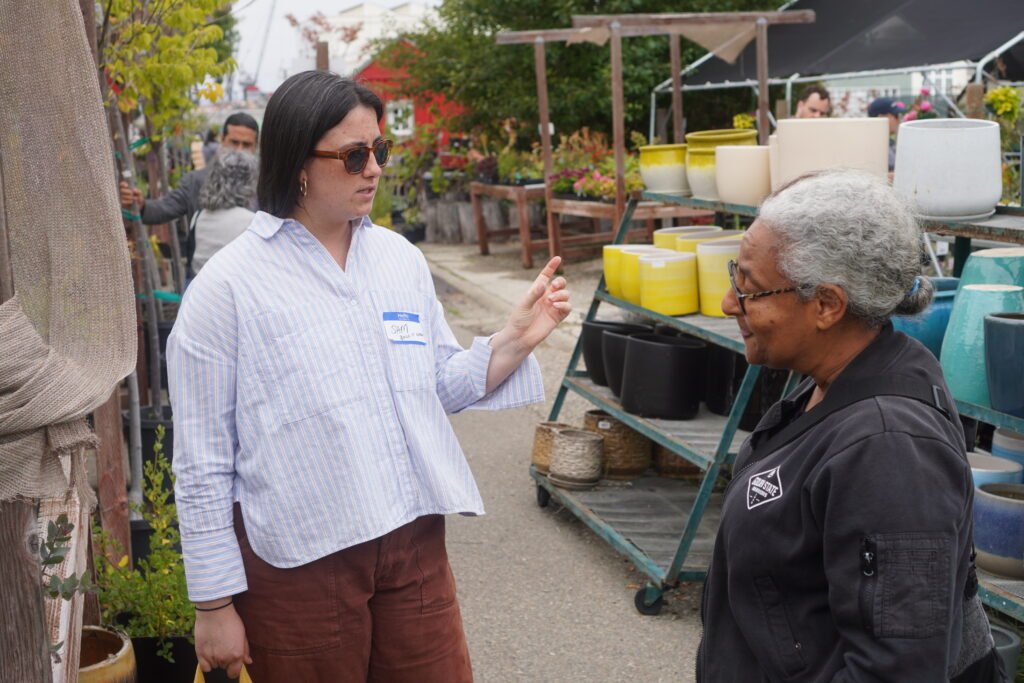
The day began at Alameda Point Collaborative, where participants from across the housing ecosystem — developers, community organizers, public servants, and residents — came together for honest conversation about the potential of Alameda Point
The conversation dug deep into affordability, infrastructure, market forces, and state mandates. One speaker explained that, due to state policies, Alameda Point, entitled for market-rate housing development, has a minimum 25% affordable housing requirement. Others raised questions about how affordability is calculated, how subsidies might carry over, and how significantly public policies, like California’s Surplus Land Act, affect development timelines and community benefit.
“The site has to be raised,” another participant pointed out, underscoring the costly need for flood protection before any housing can move forward. “If we had the room to do more community contributions, we would — but I’m just not sure we will after taking care of all the survival stuff.”

Use Smart Tools to Simplify Decisions

Conversations also turned to the role of long-time residents. “What we don’t want is for that community — which is a neighborhood, a human fabric — to be destroyed,” one housing leader said. “We’re trying to make sure neighbors can stay close by to each other and that those friendships can continue.”
A participant reflected on how similar these concerns felt to other places like South Berkeley: “The collaboration is already rich. It’s about how we move at the speed of community while these larger processes unfold.”
And from a small-scale developer: “I want to build toward equity and beauty, but I don’t know where I plug in here. A map showing where innovation can live would help.”
These grounded reflections didn’t point to easy answers — but they did point to a shared desire for thoughtful change.

Exploring the Neighborhood

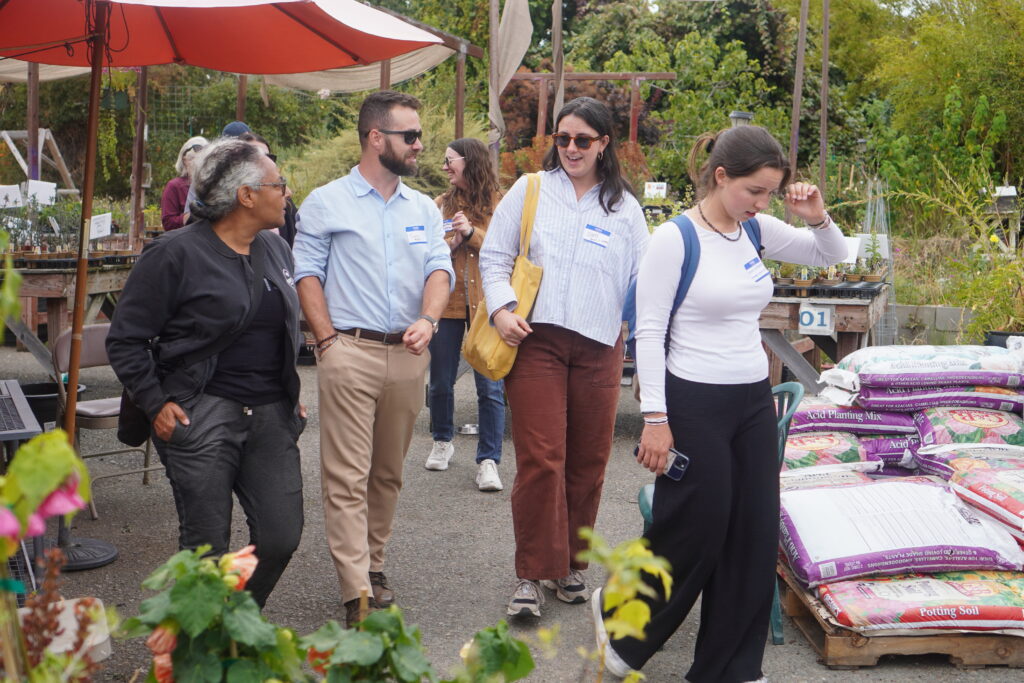
In the afternoon, the group stepped outside to explore the neighborhood. Stops included a community farm, transitional housing, and a social service hub. Local leaders shared how housing, services, and green space were being woven together through efforts like the ReShape development — a development for people who have been homeless and a collaboration between Alameda Point Collaborative, Operation Dignity, and Building Futures.
One highlight of the walk was the future site of the new “Commons,” a space envisioned to include gardens, gathering areas, and a learning center for residents. Phase one of ReShape includes 78 permanent homes with on-site services, a second 85-unit building for veterans, and spaces intentionally designed for community care. “We hope that living in a place with air conditioning, with elevators, with materials built to last — that those are good trade-offs,” said one project lead. “But the relationships are what we’re trying to protect.”
Throughout the afternoon, new questions emerged: How do we support both large-scale and small-scale development here? How do policies enable or limit community-centered work? And what are the ways people who care about this place — whether or not they live here — can stay involved?
This gathering wasn’t about reaching a conclusion. It was about paying attention — to land, to history, to the people already doing the work.
We’ll be continuing these conversations in the near future — stay tuned.

If you want more information on these ongoing conversations, please email us at [email protected].
Alex Coba

Communication Associate

As a proud California native from Stockton, Alex brings a wealth of experience and a versatile skill set. He has a solid communication background with a Bachelor of Arts in Journalism and Public Relations from California State University, Chico. Alex is adept at strategic communications and media relations, with experience gathering and sharing stories from his local communities that uplift the unique spirit and values of those places. He is excited to join Build It Green, where he can apply his talents to further BIG’s mission to help communities across California thrive